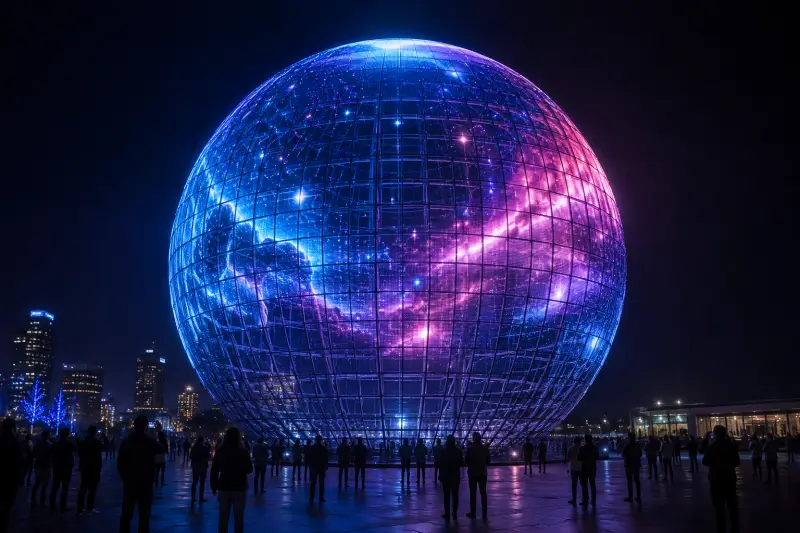
An LED sphere rental can turn a trade show booth, product launch, brand activation, or event space into a 360-degree digital experience.
But choosing an LED sphere involves more than deciding how large the display should be. The venue, pixel pitch, indoor or outdoor environment, project lead time, logistics, and content format can all change the final configuration and project cost.
If you are considering an LED sphere for an upcoming event, these are the four areas to understand before planning the project.
1. What LED Sphere Sizes Are Available?
LED spheres range from compact event displays to large-scale structures used as visual landmarks within exhibitions and brand experiences.
In an event environment, however, the practical sphere size is often determined first by the venue’s maximum allowable structure height.
Convention centers and exhibition venues have different height restrictions for temporary structures. If a venue allows structures up to 6 meters, or approximately 20 feet, a full LED sphere would need to remain within that height limit. Depending on the concept, a hemisphere or partial sphere can also be considered when a full spherical structure is not practical.
Venue confirmation usually comes before sphere sizing. Once the location is known, the applicable height restrictions and installation conditions can be reviewed before the appropriate sphere size is recommended.
Sphere size also affects the amount of LED hardware required. As the diameter increases, the total LED surface area increases, so larger spheres generally require more LED modules.
However, smaller does not always mean proportionally less expensive. A smaller sphere creates tighter curvature. Depending on the diameter, this requires more flexible LED modules or a supporting structure engineered for a tighter radius.
For more on how flexible LED modules and structural engineering affect curved displays, see our guide to Flexible Dome LED for Smooth Immersive Displays.
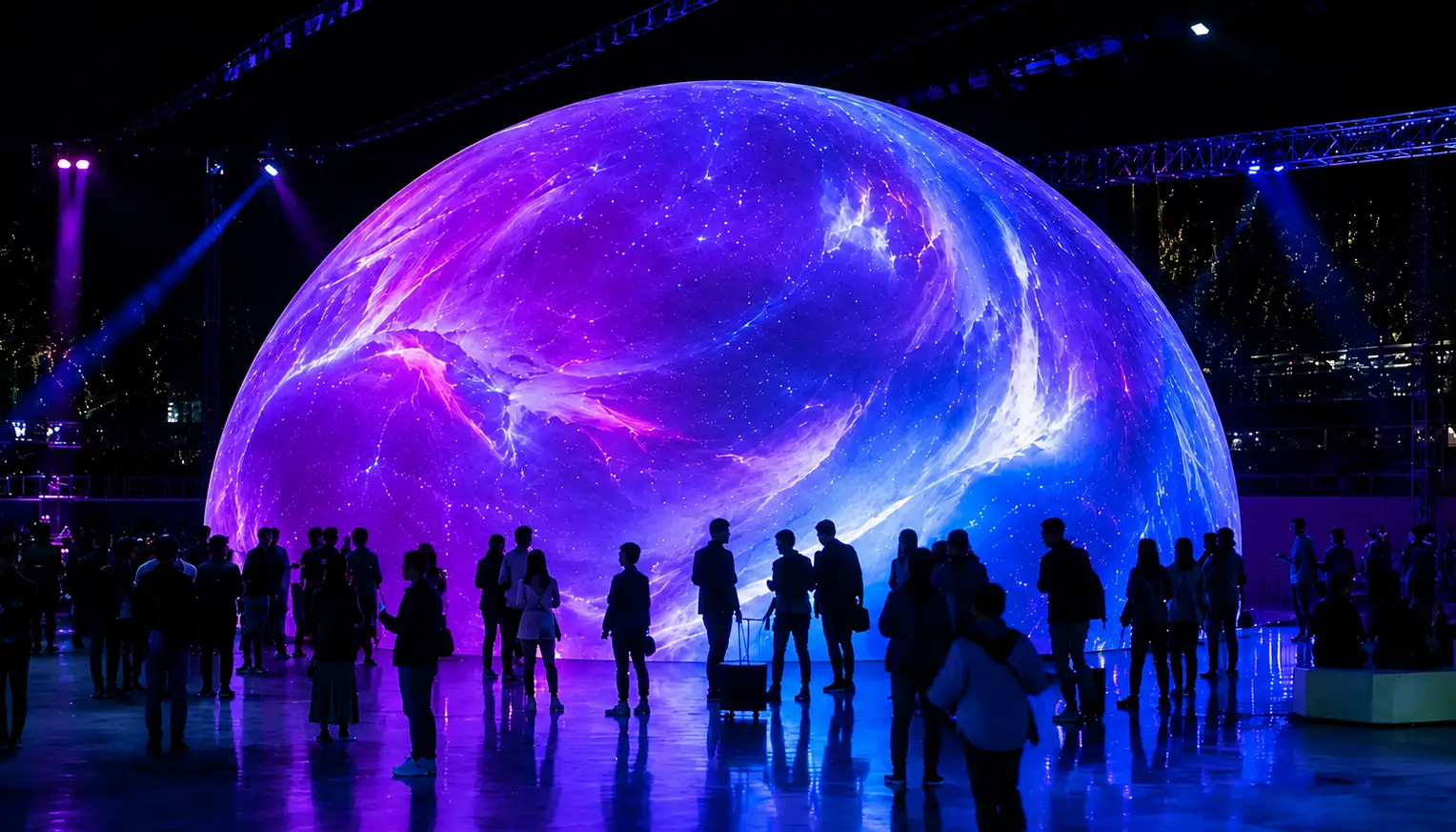
2. What Affects LED Sphere Rental Cost?
There is no single standard price for an LED sphere rental.
Sphere size and LED specification are fundamental cost factors, but two projects using similarly sized spheres can still have very different budgets depending on the installation environment, schedule, destination, logistics, and project scope.
What Is Pixel Pitch for an LED Sphere?
Pixel pitch is the distance between individual LED pixels, measured in millimeters. LED specifications such as P2.6, P2.9, and P3.9 refer to this spacing.
A smaller pixel pitch means the pixels are positioned closer together, creating a higher pixel density and allowing greater visual detail at closer viewing distances.
For an LED sphere, the right pixel pitch depends on how the sphere will be used and how close the audience will be to it.
A trade show sphere viewed from a few feet away needs a different pixel specification from a large sphere suspended above an event space.
Pixel pitch also affects hardware cost. The right pixel pitch matches the viewing distance, content detail, sphere scale, and intended use. A finer pitch is not always necessary.
Indoor vs. Outdoor
Indoor and outdoor LED spheres require different hardware and structural considerations.
Outdoor installations need to account for factors such as weather exposure, water resistance, wind, structural stability, and electrical protection. The LED specification and supporting structure may therefore be different from an indoor installation of a similar size.
Indoor or outdoor use should be confirmed before the LED and structural specifications are finalized.
Lead Time and Shipping Method
Many commercial LED display systems are manufactured and sourced from Asia, where a large portion of the LED display manufacturing industry is based. This can provide cost-effective hardware options, but it also means that shipping becomes an important part of the project budget and schedule when the equipment needs to be delivered to another market.
For projects with sufficient lead time, ocean freight is generally the more cost-efficient option. We typically recommend confirming the project at least three months before the event when ocean transportation is required, allowing time for equipment preparation, shipping, customs clearance, and local delivery.
When the production schedule is shorter, air freight or other expedited transportation may be necessary.
Because an LED sphere requires a substantial volume of LED hardware and structural components, the difference between ocean and air freight can significantly affect the total logistics cost.
Logistics, Import, and Venue Conditions
The destination of the event also affects the quotation.
Projects that require cross-border shipping can involve different freight terms, import conditions, customs clearance, duties and taxes, local transportation, and responsibilities between the parties involved.
The venue directly affects the installation approach. Access conditions, structural regulations, power requirements, and other venue-specific restrictions may need to be reviewed before the final LED sphere configuration is confirmed.
For an initial quotation, the most useful information to provide is:
- Event date
- Country and city
- Venue
- Indoor or outdoor installation
- Approximate sphere size, if already considered
- How the sphere will be used
- Whether custom content or interactive features are planned
From there, the technical and logistics requirements can be developed around the actual event conditions.
3. What Is Included in an LED Sphere Rental?
The term LED sphere rental can describe very different levels of service.
Some projects require only LED hardware. Others require a turnkey solution that brings together the sphere structure, logistics, installation, content, and technical operation.
This distinction is important when comparing rental quotations.
A hardware-only quote may not include structural planning, freight, customs, local installation, content preparation, or technical operation. These elements can represent a meaningful part of the overall project.
For a custom LED sphere, the display system, structure, logistics, and content are closely connected. Coordinating them as one project can reduce technical conflicts later in production and help ensure that the final experience performs as intended.
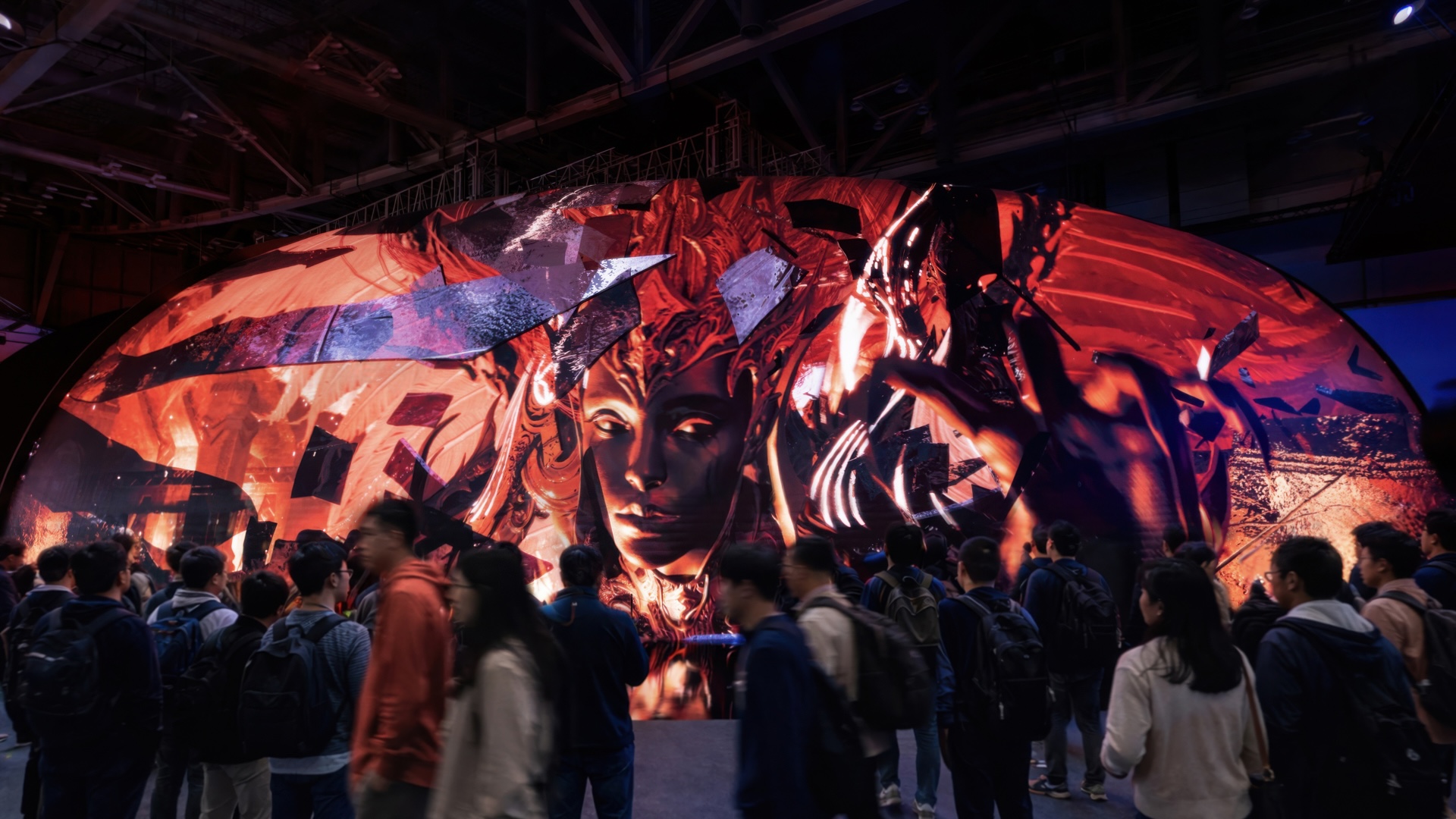
At NC’s G-STAR 2025 booth, a massive dome LED was used as the transition point into the brand’s virtual world. The 32,217-square-foot (2,993 m²) experience combined the curved LED structure with 3D anamorphic content planned and produced specifically for the space.
See the full NC 2025 G-STAR B2C case study.
4. How Should Content Be Designed for an LED Sphere?
Content behaves differently on a spherical LED surface than on a flat screen. The content format and user experience should be considered as part of the display design from the beginning.
Pre-produced motion graphics are one option, but event LED experiences are becoming increasingly interactive and experience-driven.
Depending on the project, an LED sphere can be designed for:
- Branded motion graphics and product visuals
- Anamorphic content that creates depth from a specific perspective
- Photography or video captured at the event and displayed in real time
- Interactive content triggered by touch, cameras, sensors, or other inputs
- Live or dynamic content that responds to visitor participation
These formats can create a more engaging audience experience, but they also require additional assets, technical integration, development, and testing.
Interactive and real-time content may need to connect the LED system with cameras, touch interfaces, sensors, live data sources, or custom software. Cameras, sensors, live data, or custom software add integration and testing steps to the production schedule.
Why Is Viewpoint Important for LED Sphere Content?
Viewpoint is especially important when content is mapped onto a spherical LED surface.
Because the screen curves in multiple directions, the same visual can appear differently depending on where the audience is standing. For perspective-based or anamorphic content, the creative team typically defines a primary viewing position and viewing distance before testing the content.
The content can then be evaluated from that perspective to make sure scale, depth, typography, products, and other visual elements appear as intended on the curved surface.
Not every LED sphere requires a single fixed viewpoint. A 360-degree experience designed to be viewed from multiple directions needs a different content strategy from an anamorphic installation designed around one hero perspective.
Sphere geometry, viewing perspective, content format, and interaction design work best when planned together. Adapting finished flat-screen content at the end of production limits what can be achieved on the curved surface.